


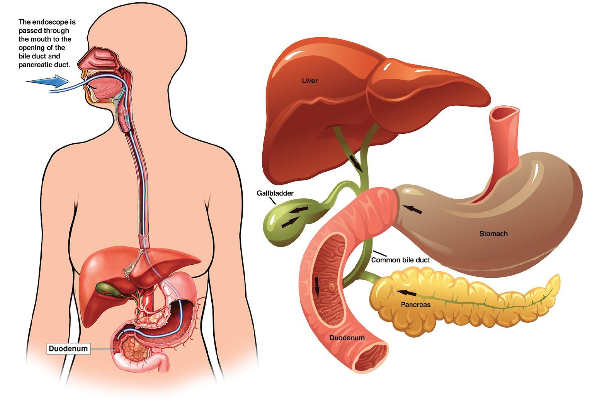
Bile plays an important role in digestion by helping the body process fats. It is produced by the liver, stored in the gallbladder, and carried through small ducts into the small intestine. When one of these ducts becomes blocked or narrowed, bile may not flow normally. This can lead to abdominal discomfort, jaundice, inflammation, and other complications, depending on the cause and severity.
Endoscopic retrograde cholangiopancreatography, commonly called ERCP, is a specialised procedure used to diagnose and treat certain problems affecting the bile ducts and pancreatic ducts. Unlike a routine diagnostic endoscopy, ERCP combines endoscopic guidance with X-ray imaging and may allow treatment during the same procedure. ERCP treatment in Panchsheel Park may be considered when a person has a bile duct blockage, certain duct stones, or another condition that requires endoscopic evaluation and treatment.
Bile ducts form a network of narrow channels that carry bile from the liver and gallbladder towards the small intestine. A blockage can occur when a gallstone moves from the gallbladder into a bile duct. Other possible causes include duct narrowing from scarring, inflammation, or an abnormal growth.
The symptoms depend on the location and extent of the obstruction. Some people develop pain in the upper right or central abdomen, particularly when a stone blocks the flow of bile. Others may experience yellowing of the skin or eyes, dark urine, pale stools, itching, or nausea.
A blockage can sometimes lead to infection within the bile ducts, known as cholangitis. This can become serious and requires urgent medical assessment. Fever or chills accompanied by jaundice or upper abdominal pain should not be ignored.
Doctors assess the symptoms, medical history, examination findings, and test results before deciding which investigation is appropriate. Blood tests may show changes in liver enzymes or bilirubin, while ultrasound, CT, or MRI-based imaging can help identify a possible obstruction.
ERCP is generally used when a bile duct or pancreatic duct problem requires treatment or when detailed duct evaluation is necessary in selected cases. It is not usually the first test for every person with abdominal pain or abnormal liver blood tests. Non-invasive imaging, including magnetic resonance cholangiopancreatography (MRCP), may provide useful information before an invasive procedure is considered.
ERCP treatment in Panchsheel Park may be considered in clinical care when investigations suggest a problem such as a bile duct stone, a narrowing that needs treatment, or a blockage requiring drainage. The decision depends on the suspected cause, the patient's condition, and whether an endoscopic intervention is likely to help.
Common reasons for therapeutic ERCP include:
Removing stones lodged in the common bile duct.
Relieving a narrowing that obstructs bile flow.
Placing a temporary or longer-term stent to help drainage.
Collecting selected samples from an abnormal narrowing when further investigation is required.
Not every blockage can be treated through ERCP. The procedure may not be suitable for certain anatomical changes or complex obstructions, and alternative endoscopic, radiological, or surgical approaches may be considered.
ERCP is performed using a flexible endoscope passed through the mouth, down the oesophagus and stomach, and into the first part of the small intestine. The clinician identifies the opening where the bile and pancreatic ducts drain. A thin catheter is then guided into the relevant duct, and contrast material is introduced to make the duct visible on X-ray images.
If a treatable blockage is identified, specific instruments can be passed through the endoscope. Depending on the findings, the clinician may widen the duct opening, remove stones using a retrieval balloon or basket, or place a stent to maintain drainage.
Before the procedure, the medical team reviews medicines, allergies, medical conditions, and relevant test results. Fasting instructions and medication adjustments are provided according to the individual's circumstances. ERCP is commonly performed with sedation or anaesthesia, with monitoring throughout.
Afterward, the patient is observed while the effects of sedation wear off. Some people can return home the same day, while others need hospital observation depending on the reason for the procedure, their overall health, and whether complications are suspected.
ERCP can treat certain obstructions without open surgery, but it is an invasive procedure and carries risks. One important complication is pancreatitis, which means inflammation of the pancreas after the procedure. Other possible complications include bleeding, infection, or, less commonly, a perforation in the digestive tract.
The risk depends on factors such as the reason for ERCP, the complexity of the intervention, and the person's medical history. Clinicians may use preventive measures, including medication or specific procedural techniques, when appropriate.
Recovery instructions depend on the procedure and the patient's condition. Temporary throat irritation or mild bloating may occur. Eating and drinking are resumed according to the medical team's guidance, and driving should be avoided for the period advised after sedation.
Warning signs after ERCP include severe or worsening abdominal pain, persistent vomiting, fever, chills, black stools, or significant bleeding. These symptoms require urgent medical assessment rather than waiting for a routine follow-up.
Removing a stone or placing a stent addresses a particular obstruction, but follow-up may still be needed to manage the underlying cause. For example, a person with gallstones may require a separate discussion about gallbladder management to reduce the risk of further episodes. A narrowing may need additional imaging, tissue sampling, or repeat procedures depending on its cause.
The type of follow-up depends on the ERCP findings and the treatment performed. If a temporary stent has been inserted, the care team should explain whether and when it needs removal or replacement. Leaving a temporary stent in place beyond the recommended period can lead to further problems.
Patients should understand the findings, the purpose of any stent, medication instructions, and the symptoms that require prompt attention. Follow-up blood tests or imaging may be advised to check whether bile flow has improved.
The goal of evaluation is to identify the cause of the blockage, relieve it safely when possible, and address any condition that could lead to recurrence. The appropriate plan varies with each person's diagnosis and overall health.
1. Is ERCP used to remove bile duct stones?
Yes. ERCP can remove many stones from the common bile duct using specialised instruments. The approach depends on the size, number, and position of the stones.
2. Is ERCP the same as an ordinary endoscopy?
No. ERCP uses an endoscope along with X-ray imaging and contrast material to examine and treat selected bile and pancreatic duct problems.
3. Can a bile duct blockage cause jaundice?
Yes. When bile cannot drain normally, bilirubin may build up in the blood, causing yellowing of the skin and eyes. Jaundice requires medical evaluation to identify its cause.
| Tags: | #ERCP treatment in Friends Colony, # ERCP treatment in Chanakyapuri, # ERCP treatment in New Delhi, # ERCP treatment in South Delhi |


